Which searches on your website find nothing, and what to do about it
By Moha Ousaid Saaid, founder · Updated · 5 min read
To find which searches on your site return nothing, list the terms people type into your search box and run each one yourself, or have your results page report its count to your analytics. Each empty search is someone telling you what they wanted in their own words. Most have one of four causes, and only one of those means you should stock something new.
Why does an empty search matter more than a page view?
A page view tells you someone arrived. A search tells you what they came for, typed by them. When it returns nothing, your site has said no to a person who was actively asking, and nothing in a standard traffic report shows it happened.
So this list is worth reading even if you never look at another report. It's short, it's in your customers' own language, and many of the fixes take minutes.
How do you find which searches return nothing, with any tool?
First get the terms. If your results page has the term in its address, such as /search?q=heat+pump, most analytics tools can collect it. Google Analytics 4 does this with enhanced measurement: it records a view_search_results event when the address carries q, s, search, query or keyword, and stores the term. Google's page doesn't mention result counts, and the event depends on the address, so expect a list of terms without a verdict on each one.
Then run the test no tool can skip:
- Export your top 20 search terms for the last 30 days.
- Add the five terms you'd expect people to use for your best sellers, even if they aren't on the list.
- Type each term into your own search box, on your phone. Write down the number of results.
- Mark each one: nothing, something wrong, or good. "Something wrong" means results you wouldn't show a customer, such as phone cases for a search for phones.
- Repeat the empty ones without accents, with one spelling mistake, and in any other language your customers use.
It takes about 20 minutes. A single run often turns up something you can fix the same day.
What can you do without result counts?
Use the next-best signal: did the visitor open another page after searching? Someone who searches and then does nothing probably didn't find it. Some of them got what they wanted from the results list, so treat it as a lead and test it by hand.
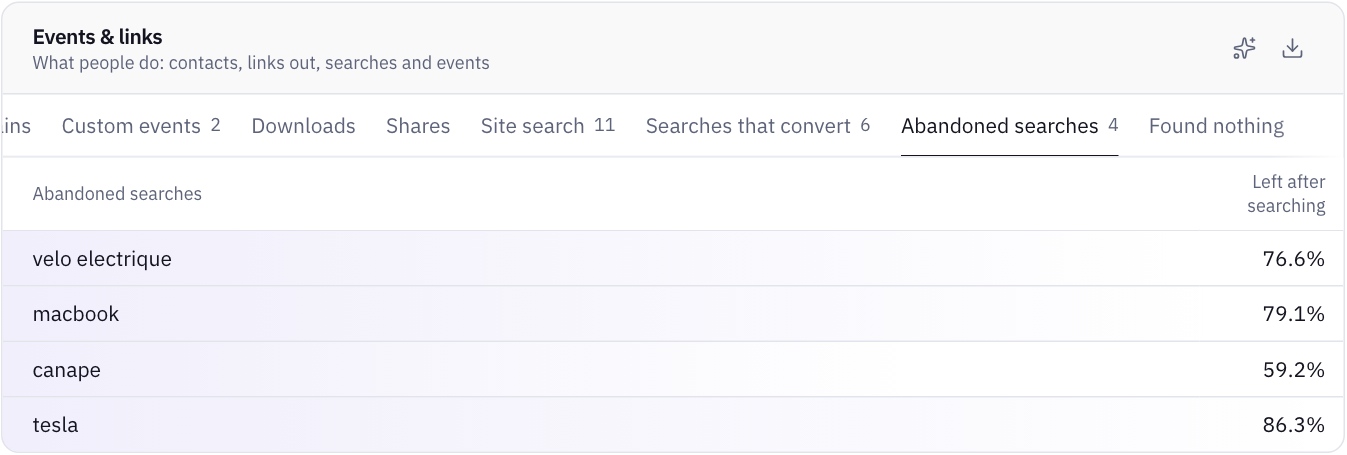
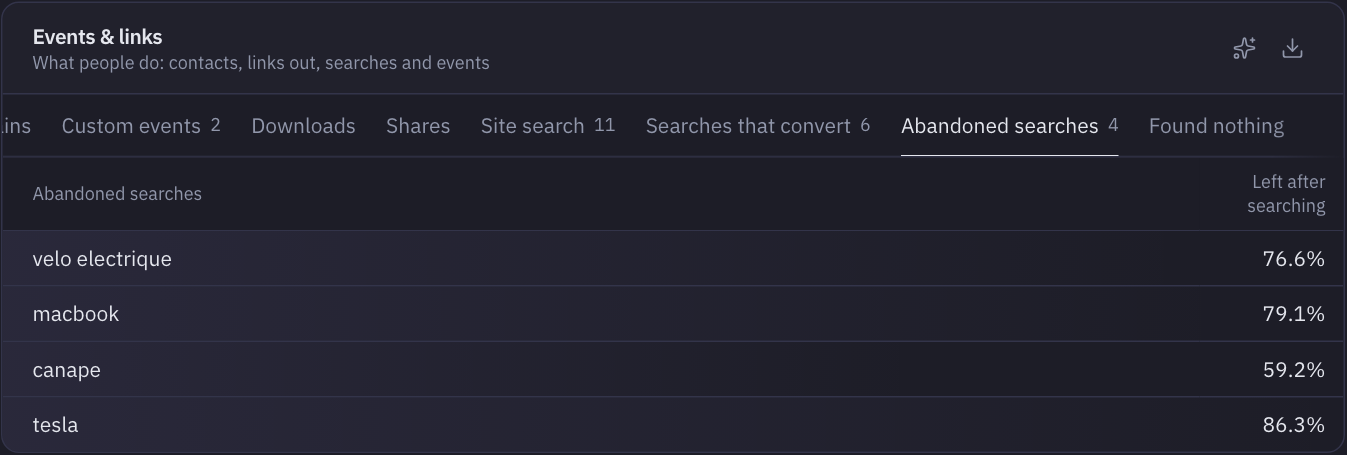
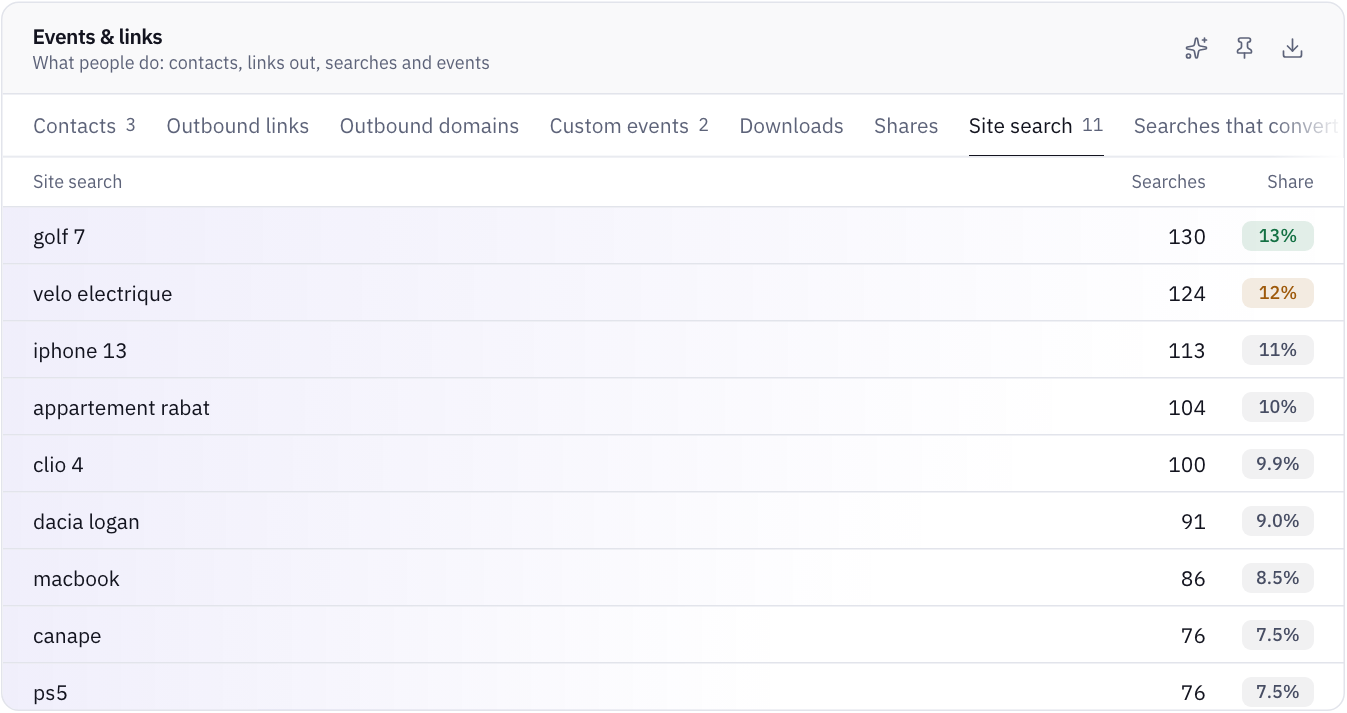
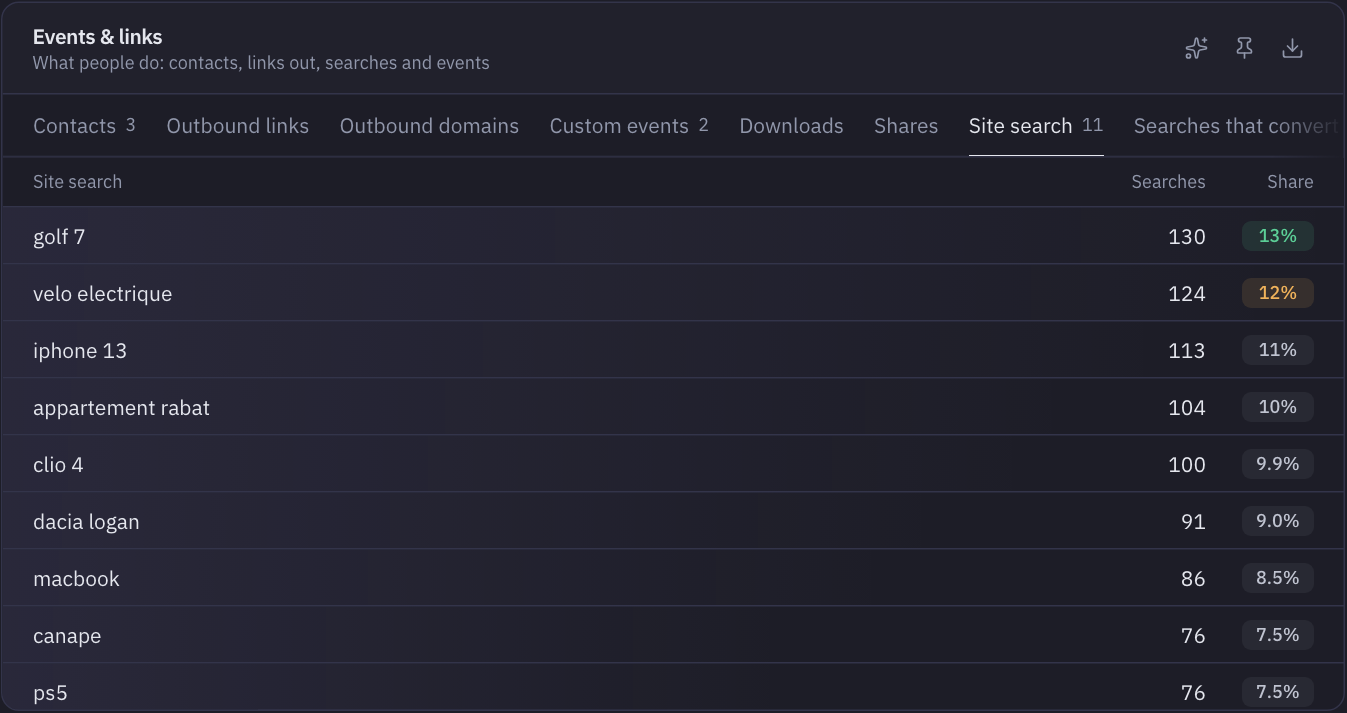
The demo marketplace below doesn't report result counts on its web pages, so its Found nothing tab is empty and tells you how to fill it. Its Abandoned searches tab still gives you a useful list.
Which empty search should you fix first?
A high exit rate on a term three people searched means little. A rule needs both size and failure. Here's the one our briefing uses to decide a term deserves a written finding: at least 10 searches in a week, from at least 5 visitors, with at least 60% leaving straight after. It then ranks by searches multiplied by the exit rate.
You can do that on a napkin. Here's the demo site, using 30 days rather than a week, because the arithmetic is the same:
| Term | Searches | Left after | Searches × left | Rank |
|---|---|---|---|---|
| velo electrique | 124 | 76.6% | 95 | First |
| macbook | 86 | 79.1% | 68 | Second |
| tesla | 51 | 86.3% | 44 | Third |
| canape | 76 | 59.2% | 45 | Under 60%: leave it for now |
Look at tesla, which has the worst exit rate and the fewest searches, and comes third. Sorting by exit rate alone would have sent you there first. canape loses as many people as tesla, but more of its searchers carry on, so something is working.
When a term is keyboard mash like zqxjvwkpl, skip it. Our rule treats a Latin-script term with no vowels as noise, and you can apply the same quick test by eye.
What does an empty search actually mean?
| Cause | How to tell | What to do |
|---|---|---|
| Spelling or accents | The term works with the accent or the correct spelling. Try vélo électrique against velo electrique | Ask for accent-insensitive search with typo tolerance. Many search tools have a setting |
| Different words | You sell it, under another name: people search sofa, you list canapé | Add the synonym to the search settings and to the product text |
| Search is broken or narrow | An exact product name finds nothing, or search only reads titles and misses descriptions | Fix the index, widen the fields, and re-run your 25 terms |
| You don't have it | No variant finds anything, and it isn't in your catalogue | This one is demand. Decide whether to stock it, and if not, point the empty page at the nearest alternative |
Go through the causes in this order, because the first three are cheap and the fourth is a business decision. Only stock something new after you've ruled out the rest. A term with steady searches across months is better evidence than one spike.
What should an empty results page say?
- Say what happened in words, and repeat the term, so visitors can spot their own typo.
- Offer a next step: your top categories, the closest matches, or a way to ask you. A phone or WhatsApp link on this page gives a stuck visitor somewhere to go.
- Don't leave a heading that reads "Results" over nothing. It looks like a broken page.
Then watch what happens. If people who hit your empty page now open another page or contact you, your fallback works. If the same term stops showing up as abandoned, your fix worked.
How MetricMind shortens this
MetricMind records site search automatically when the term is in the address, using q, query, search, s, keyword, k or term. You can name another parameter with data-search on the script. Terms that look like an email address or a phone number are never sent.
To count empty searches, the results page has to say so. It can state the count in a short visible line, such as "12 results" or "No results", in English, French, Spanish, German, Italian or Arabic. Or you can add one attribute:
<div data-mm-results="0">No results</div>Then the panel fills in, along with these views:
- Found nothing: every term that returned no results.
- Abandoned searches and Searches that convert: which terms people leave on, and which lead to a contact.
- A written finding when one term passes the rule above, or when 5 or more searches over 3 or more terms found nothing. These are worked out with no AI model and don't count as investigations.
- The visits behind a term, so you can see what someone did before and after searching.
It only counts what your search box tells it. It can't tell you whether results were any good, so keep doing the phone test once a month. Read more on site search in MetricMind, and if searches aren't your main worry, start with visitors who don't become customers. If you've just fixed something, here's how to tell whether it helped.
Your next step
See a real list of abandoned searches
The live demo is a sample marketplace with its searches, what visitors did next, and which terms led to a contact. No sign-up.