PostHog vs MetricMind: when you don't need a product analytics suite
By Moha Ousaid Saaid, founder · Updated · 5 min read
You probably don't need a product analytics suite if your questions are about pages, sources and contacts, and nobody on your team will define events and build reports. If you have a logged-in product and engineers who want session replay, SQL or a data warehouse, choose PostHog. It's more complete, has a generous free tier and is years ahead of us in maturity. MetricMind is for owners who want those answers with no setup.
What's the difference between web analytics and product analytics?
Web analytics tells you how many people came, from where, and to which pages. Product analytics follows what specific users do inside a product over time. PostHog's own explanation puts it well: web analytics is one pre-built dashboard, and product analytics lets you build custom insights and dashboards around any event.
PostHog offers both, plus much more. A marketplace owner, a shop or a dentist usually needs something in between: more than page counts, less than a toolkit.
A test: do you need a suite?
Write down the last 10 questions you asked about your website or app, or wish you could have asked. Then sort them.
| Question type | Example | Suits |
|---|---|---|
| About traffic | Where did last week's visitors come from? | Either |
| About contacts and leads | Which pages lead to WhatsApp messages? | MetricMind, with no setup. PostHog, once you define it |
| About something broken | Why did contacts drop on Tuesday? | Either. PostHog can show a replay of it |
| About one user's path through a product | Do users who invite a teammate in week one stay? | PostHog |
| About watching what happened | What did this customer see before they complained? | PostHog. MetricMind records nothing on screen |
| About joining other data | How does this compare with my CRM and billing data? | PostHog, through its data warehouse |
If three or more of your 10 fall in the last three rows, and someone on your team will do the building, use PostHog. If nearly all fall in the first three, a suite gives you many tools you'll pay for in attention and never open. The cut-off is our judgement, so move it if it doesn't fit you.
How do the two compare?
| Compared | PostHog | MetricMind |
|---|---|---|
| Free tier | 1M events, 5K recordings, 1M flag requests, 100K exceptions, 1,500 survey responses a month. No card | 10k page views and your own events a month, 10 analyst questions plus 1 a day. In private beta |
| Beyond free | Pay per use, per product | Plans from $8. Pro is $39 for 1M page views and your own events, prices after the beta |
| Session replay | Yes, web and mobile | No. Visits are rebuilt from events, with nothing on screen recorded |
| SQL and data warehouse | Yes | No warehouse. CSV export and a query API |
| Source code | MIT-licensed open source edition | Closed |
| Contacts by channel, search with no results, abandoned form fields | Autocapture records clicks, form submissions and changes. You define what counts | Named reports from the first day |
| AI | PostHog AI, 500 credits a month free | An analyst on every plan, with its query shown. Investigations from Pro up |
| Device storage | First-party cookie by default, cookieless mode available | No cookies. A random ID in site storage by default, storage-free mode available |
| Hosting | US or EU (Frankfurt) cloud, or self-hosted | Germany. Analyst answers also use a model provider |
| Script, gzipped | array.js about 107 KB, recorder file about 67 KB, measured by us | mm.js about 12 KB |
| Data retention | 1 year on free, 7 years on paid, recordings 1 month on free | 13, 25 or 37 months, your choice; 25 on new websites |
What does PostHog do better?
Quite a lot, and it's worth saying plainly.
- Session replay. If you need to watch a visit, we don't do that and don't plan to. See session replay vs privacy for what you give up and gain.
- Depth. Custom insights, notebooks, SQL, a data warehouse and many ways to cut user behaviour. Our trends, cohorts and funnels are simpler.
- The free tier. One million events a month for free is 100 times our free plan's count, even though we don't count speed measurements or automatic events. For a developer with a side project, it's the obvious start.
- Experiments with options. Its best practices describe a sequential testing mode that lets you check results as they arrive. Ours has one fixed plan.
- Maturity. It says more than 600,000 companies use it. Its mobile replay is generally available on Android, iOS, React Native and Flutter, while our mobile SDKs are in beta.
- Open source. You can run it yourself. You can't run ours.
What does MetricMind do better?
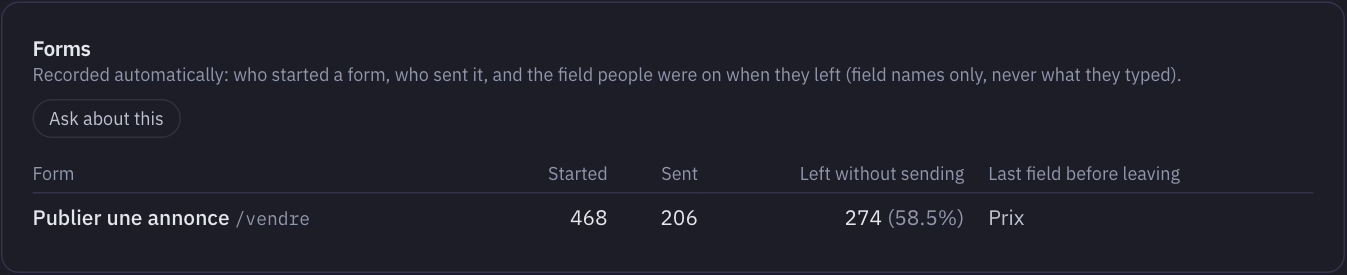
It answers an owner's questions on the first day, with no one to build reports. Add one line and the dashboard has contacts by channel, searches that found nothing, the field where people left a form, and frustrated pages. PostHog can reach most of this, but a person has to decide what to define and then keep it working.
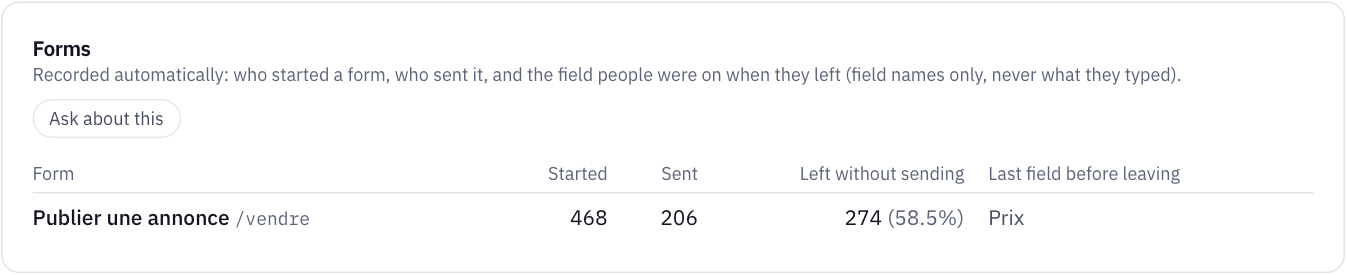
And there's nothing to mask. A recording tool has to be told what's sensitive, and PostHog's privacy controls say inputs are masked by default while general text isn't. That's a sensible default for its users, but somebody has to check it. A tool that records no screen has no such job.
The script is also smaller, which matters on phones on slow networks. It isn't the smallest around: Plausible and Fathom beat us on that.
Can you use both?
Yes, and for some teams it's the right answer. Marketing and the owner read MetricMind for the website. Engineers use PostHog inside the logged-in product. Both add a script, though, so check your speed afterwards. The two will also disagree on numbers, as any two tools do, so decide which one reports what.
If you start with PostHog and later want to move, MetricMind can import a PostHog export file. Going the other way, you can export CSV or use the query API.
What would we do in your place?
- A SaaS product with developers: start with PostHog. You'd outgrow us on questions about user behaviour.
- A shop, marketplace or lead-generation site with no developer on hand: try MetricMind. A suite will sit half-configured.
- A site with no budget and someone technical: PostHog's free tier, or GA4 if you depend on Google Ads.
- Unsure: run the 10-question test above before you install anything. It takes about 10 minutes, and it's cheaper than an abandoned setup.
For the wider decision, see how to choose a Google Analytics alternative, and our feature list for what's in MetricMind today.
Your next step
Try the owner's side of this comparison
Open the live demo, a sample marketplace. Check whether its reports answer your 10 questions. No sign-up.